
 Phone:

Best Penetration Testing Services: 6 Providers
A penetration test is an authorized attack simulation that checks whether a weakness can be used to reach systems or data. The hard part is choosing a test that fits your risks and getting findings your team can act on. Here are six providers with different testing scopes and delivery models, plus what to check before you sign.
1. NetSPI: Offensive security testing across enterprise environments
NetSPI provides human-led penetration testing supported by a platform. Its testing covers web and API applications, mobile, cloud, internal and external networks, wireless, hardware, mainframes, and AI or machine-learning systems. It also lists red-team work and social engineering.
This is a fit to consider when your company needs repeat testing across a large or varied environment. NetSPI describes its model as contextualized PTaaS, or penetration testing as a service. A PTaaS model combines human testing with a platform for managing findings and engagement work.
The platform can hold reports and findings across engagements. Teams can sort and filter findings, track remediation, and schedule tests to confirm whether fixes worked.
That workflow can help when several teams own different systems. For example, a security lead can assign a finding to an application owner, while leadership reviews a summary of the test. The platform also supports communication with the project manager about assessments and upcoming work.
NetSPI’s engagement model is quoted per endpoint. Ask what counts as an endpoint in your scope and how the quote changes when you add a cloud account, application, or network segment. Confirm whether retesting is included, too. A platform can make results easier to manage, but it doesn’t replace clear scope or named deliverables.
If your team already has monitoring in place, plan how test findings will reach the people who respond to alerts. AdvancedTechCo’s managed detection and response services are relevant to that ongoing alert workflow, though they are not a substitute for a penetration test.
2. Bishop Fox: Broad application, cloud, and emerging-technology assessments
Bishop Fox covers application, mobile, secure-code, cloud, network, hardware, and AI or large-language-model security assessments. Its portfolio also includes red teaming and social engineering. This breadth may suit organizations that need one provider to assess several kinds of technology.
For application teams, the work includes web and mobile testing, AI-powered portfolio assessments, and secure code review. Cloud testing can look at services such as AWS, Google Cloud, and Azure, along with other environments. The goal is to examine paths an attacker might use, rather than rely only on a configuration checklist.
That distinction matters in a hybrid setup. A company may run a customer portal in the cloud while keeping identity systems or business records on its own network. Scoping should spell out which accounts, services, applications, and network boundaries are in the test. Ask how the provider will handle shared systems and third-party connections so the test stays within written authorization.
Bishop Fox says its reports pair technical detail with an executive view. It also offers customized reporting, weekly status updates, and a post-engagement review. Ask for a sample report with sensitive details removed. Check that it shows evidence for each finding, its severity, the likely impact, and a clear fix path.
The wide scope is useful, but it can also mean more scoping work. Decide whether you need a focused application test or a broader review before requesting a quote. If mobile applications are in scope, AdvancedTechCo’s mobile security guidance can help your team think through device and account risks alongside the test.
3. Rapid7: Network, web application, and mobile penetration testing
Rapid7 lists penetration testing for networks, web applications, mobile applications, wireless systems, and social engineering. Its service also includes red-team attack simulation. This provider may suit a team looking to test a defined set of systems or people-focused risks.
A network test can help show whether an exposed service or an internal weakness creates a path to sensitive systems. A web application test looks at a customer-facing site or internal app. Mobile testing focuses on mobile applications. These are separate scopes, so don’t assume a quote for one includes the others.
Rapid7 describes its testing as a way to identify weaknesses in people, processes, and technology. Its reports include strategic recommendations aimed at improving security controls and programs. Before you buy, ask how the final report will separate verified issues from lower-confidence observations. Also ask whether the team will walk your staff through the findings.
For a meaningful test, automated scanning should support the work, not stand in for it. A scan can find known issues quickly, but hands-on testing checks whether a weakness can be used and what an attacker might reach next. Ask the provider how testers validate findings and how they avoid disrupting production systems.
If your company is moving workloads or changing how staff access systems, include those changes in the scope discussion. AdvancedTechCo’s cloud services for New York businesses cover cloud planning and support, which can help your team keep operational changes visible as you plan security testing.
Rapid7’s testing scope is clear, but buyers should confirm the exact deliverables, timing, and retest terms in the statement of work.
4. NCC Group: Testing for applications, infrastructure, networks, and cloud
NCC Group covers applications, infrastructure, networks, cloud, and specialist environments. Its services include manual, hybrid, and attack-simulation approaches. That range can suit organizations with several environments or a need to test more than a standard external network boundary.
For application work, the scope includes web and mobile apps, plus native or compiled applications. Infrastructure testing can include manual reviews of systems and network devices. Cloud reviews may include configuration checks and container or orchestration setups. In a hybrid environment, ask how the provider will connect findings across cloud identity, on-premises systems, and network access.
NCC Group describes a hybrid approach that uses automation alongside manual testing. Manual work can help uncover issues that depend on business logic or a chain of actions across systems. Automation can help cover routine checks. Ask which parts of your scope will be tested by a person and which will use tools, then make sure the report makes that distinction clear.
Reports should give your team enough detail to verify a finding and assign the fix. Confirm the severity scale, evidence format, and remediation advice before signing. If your team lacks time to review results, ask whether the provider will hold a debrief and explain the most urgent items in order.
Some organizations also need a test that checks how staff respond to a simulated attack. NCC Group lists social engineering and red, purple, and black team services. These are not interchangeable with a standard application test, so name the business goal and the allowed actions in the scope.
For firms that need help tying security work to wider IT planning, AdvancedTechCo’s IT consulting services can support technology planning. Whichever provider runs the test, make sure its written scope matches your assessment needs.
5. Coalfire: A strong option for regulated and compliance-focused testing
Coalfire is a U.S.-based security and compliance provider with offensive security services, plus advisory and assessment work for programs such as FedRAMP and CMMC. It is a notable option to assess when a penetration test is tied to compliance work.
A credential or assessor status does not automatically mean every test meets your specific audit need. Ask which team will perform the test and what evidence the engagement will produce for your assessor or customer.
Compliance terms can mean different things in practice. A buyer should name the applicable requirement and ask the provider to map the test scope to it in writing. For example, identify the systems that store or process payment data before discussing a PCI-related assessment. If you handle regulated health information, clarify which applications and access paths are in scope.
Also check whether the engagement is a penetration test, an audit, or a readiness assessment. These activities have different goals. A penetration test tries to validate security weaknesses within an authorized scope. An audit evaluates controls against a standard. Don’t accept a general compliance label in place of a specific test plan.
Get the contract details clear before work starts. The statement of work should name test targets, dates, allowed techniques, emergency contacts, data handling, and rules for stopping the test. Include a confidentiality agreement where needed, and ask what happens if the test affects a live service.
Coalfire’s compliance focus makes it worth reviewing for regulated work, but confirm its current assessor status and scope directly with the provider. A credential only helps when it applies to the people and service you are buying.
6. Bugcrowd: Platform-based PTaaS with continuous and on-demand options
Bugcrowd provides PTaaS through a platform, with standard, customized, continuous, and on-demand testing options. Scopes include web applications, networks, APIs, mobile apps, cloud, IoT, hardware, cryptography, binaries, and operational technology. This model can fit teams that want visibility into testing activity between formal report dates.
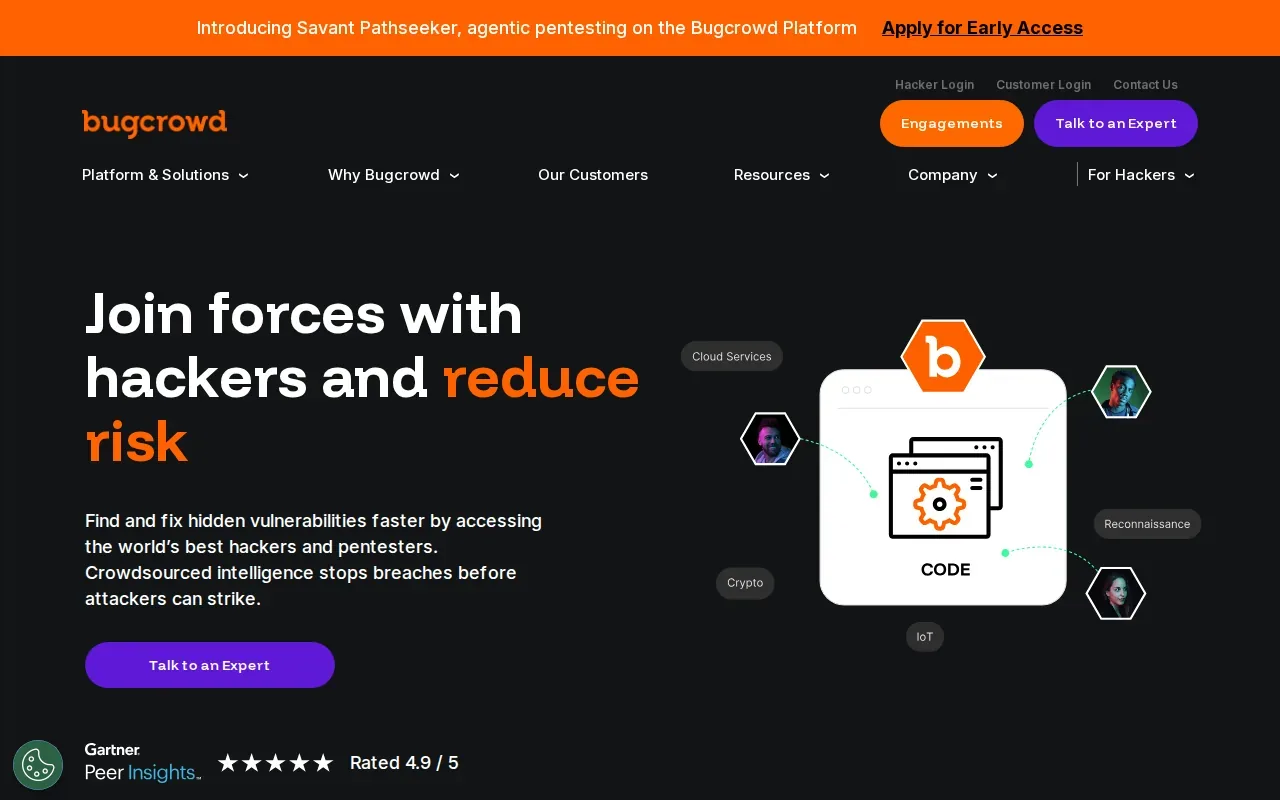
The platform is designed to show test progress and prioritized findings through a dashboard. That can help an engineering team see an issue while the relevant code or system owner is still working on it. Ask how findings are validated, who can view them, and how the final report will meet your audit or customer requirements.
PTaaS can change how a business plans testing. A one-time engagement gives a defined assessment window and report. A continuous option can suit a fast-changing environment, but recurring access alone does not guarantee deeper testing. Ask what gets tested in each cycle, how the scope changes, and whether the same testers stay involved.
Bugcrowd uses both automated scanning and human testing. Ask the provider to explain the role of each. Automated checks can find common issues, while a human tester can examine how multiple weaknesses interact or test application logic. Your report should make the evidence and validation clear.
For a small team, a dashboard may help track owners and fixes without building a separate workflow. Still, decide who will act on each finding. If the report lands with a busy IT manager and no system owner is assigned, even a high-priority issue can sit unresolved.
Bugcrowd gives buyers several engagement models. Compare those options against your release pace and audit dates, then confirm cost and retesting terms in the written proposal.
Compare These Penetration Testing Services
Use this matrix to narrow the shortlist by scope and delivery style. It isn’t a quality ranking, and it doesn’t replace a scoping call. Ask each provider the same questions about test depth, report contents, retesting, and who will perform the work.
| Provider | Scope highlighted here | Delivery angle | Good fit to explore | Confirm before signing |
|---|---|---|---|---|
| NetSPI | Applications, networks, cloud, hardware, and specialist systems | Human-led PTaaS with a findings platform | Large or varied testing programs | Endpoint definition, price basis, and retest terms |
| Bishop Fox | Application, cloud, network, hardware, and AI security | Tailored assessments with reporting and reviews | Organizations with broad technical scopes | Exact assets, schedule, and report format |
| Rapid7 | Network, web app, mobile, wireless, and social engineering | Defined testing services and strategic recommendations | Teams assessing specific systems or people risks | Manual testing, price, and retesting |
| NCC Group | Applications, infrastructure, networks, cloud, and specialist areas | Manual, hybrid, and simulation options | Complex or hybrid environments | Tester roles, scope boundaries, and deliverables |
| Coalfire | Offensive security with compliance assessor credentials | Compliance-focused evaluation | Work linked to federal, payment, or CMMC needs | Credential scope and audit evidence required |
| Bugcrowd | Applications, networks, APIs, cloud, IoT, and more | Platform-based standard, custom, or recurring tests | Teams that want ongoing platform visibility | Tester continuity, validation, and report needs |
These providers price their work in different ways, so request quotes using the same asset list and service expectations. A quote should say what is out of scope, how findings are rated, whether a debrief is included, and when a retest can happen.
Before approval, ask for a sample report and confirm the rules of engagement. Your agreement should define authorized targets, test timing, data handling, confidentiality, escalation steps, and limits on disruptive actions. If the test affects a vendor-hosted or shared service, get permission and ownership clear first.
Small and midsize companies often need support after the report arrives. AdvancedTechCo provides managed IT and security support, including penetration testing and vulnerability testing through our managed security services, so our team can also help with remediation planning after the report.
Frequently Asked Questions About Penetration Testing Services
What do penetration testing services include?
Penetration testing services include an authorized attempt to find and safely validate weaknesses within an agreed scope. The work often moves through scoping, reconnaissance, testing, controlled exploitation, reporting, and remediation planning. The exact methods depend on the system being tested. Ask whether the provider will test manually, use automated tools, or combine both.
How is a penetration test different from a vulnerability scan?
A penetration test tries to confirm whether weaknesses can be used to reach a system or data. A vulnerability scan mainly identifies possible issues for review. Scanning can support a test, but scan output alone may not show how an attacker could chain weaknesses together. Ask what evidence the provider will include in its report.
How often should a business get a penetration test?
Many businesses schedule tests around compliance needs, major system changes, or changes to their risk. A growing application may need testing more often than a stable system. PTaaS can support recurring work, but the schedule should match your release pace and risk. Confirm any required timing with your auditor, customer, or insurer.
What should a penetration test report include?
A useful report should describe each verified finding, its severity, supporting evidence, likely impact, and remediation advice. Ask for an executive summary as well as technical detail for the people who will fix the issue. Confirm whether the provider includes a debrief and retesting, since those terms can vary by engagement.
Do small businesses need penetration testing?
Small businesses may need a test when they handle sensitive data, face a customer or insurance requirement, or want to check a high-risk system. Start with the business goal and a narrow scope, such as an internet-facing application or network. AdvancedTechCo offers penetration and vulnerability testing as part of its managed security services for businesses in New York, New Jersey, and Connecticut.
Conclusion
Choose the provider whose scope matches the systems you need tested and whose report gives your team clear next steps. Before signing, request a sample report and confirm the scope, retest terms, and engagement rules in writing. For ongoing IT support after the assessment, explore how AdvancedTechCo can help your team focus on your business with greater peace of mind.

0 comment