
 Phone:
Best Network Cabling NYC Services
A bad cable run can slow work, break VoIP calls, and leave your team guessing when a device drops offline. The right provider can plan the layout, install the cable, test each run, and leave clear records behind. Here are the best network cabling NYC service options, with a clear fit for each type of project.
1. AdvancedTechCo
AdvancedTechCo is a managed IT provider that can connect cabling work to the rest of your business technology. We support small and midsize businesses across New York, New Jersey, and Connecticut.

We’re the best fit when your cabling project is part of a larger IT need. That might mean a new office, a network refresh, a cloud move, or a VoIP upgrade. A cabling crew can install the physical connection. A managed IT partner can also help make sure your switches, wireless access points, phones, workstations, and security tools work together after the install.
That handoff matters. Imagine moving into a new office with fresh data drops. The cable passes its test, but the wireless access points are placed in the wrong areas. Or the new VoIP phones need power over Ethernet that the current switch cannot supply. A project that looked complete now needs another visit and a second round of changes.
AdvancedTechCo provides managed IT services with 24/7 remote helpdesk support, onsite support, security, cloud migration, and VoIP phone services. We can help scope the technology around the cable work, then support the network after the installer leaves.
Our network support services in New York are useful when you need ongoing monitoring and help after a cabling project. We provide that support so you can focus on your business instead of chasing faults between a patch panel and a switch.
The main caveat is scope. AdvancedTechCo is a managed IT provider, so you should confirm the exact installation work, materials, testing, and project ownership before signing. Ask who will handle wall access, permits, firestopping, labeling, and closeout documents.
For businesses that want one technology partner after the build, this is the strongest starting point.
2. Local Structured Cabling Integrators, End-to-end office network installations
Local structured cabling integrators are a good choice for businesses that need a full office wiring project rather than a single repair. They plan the layout, install cable, organize the network closet, and test the finished runs.
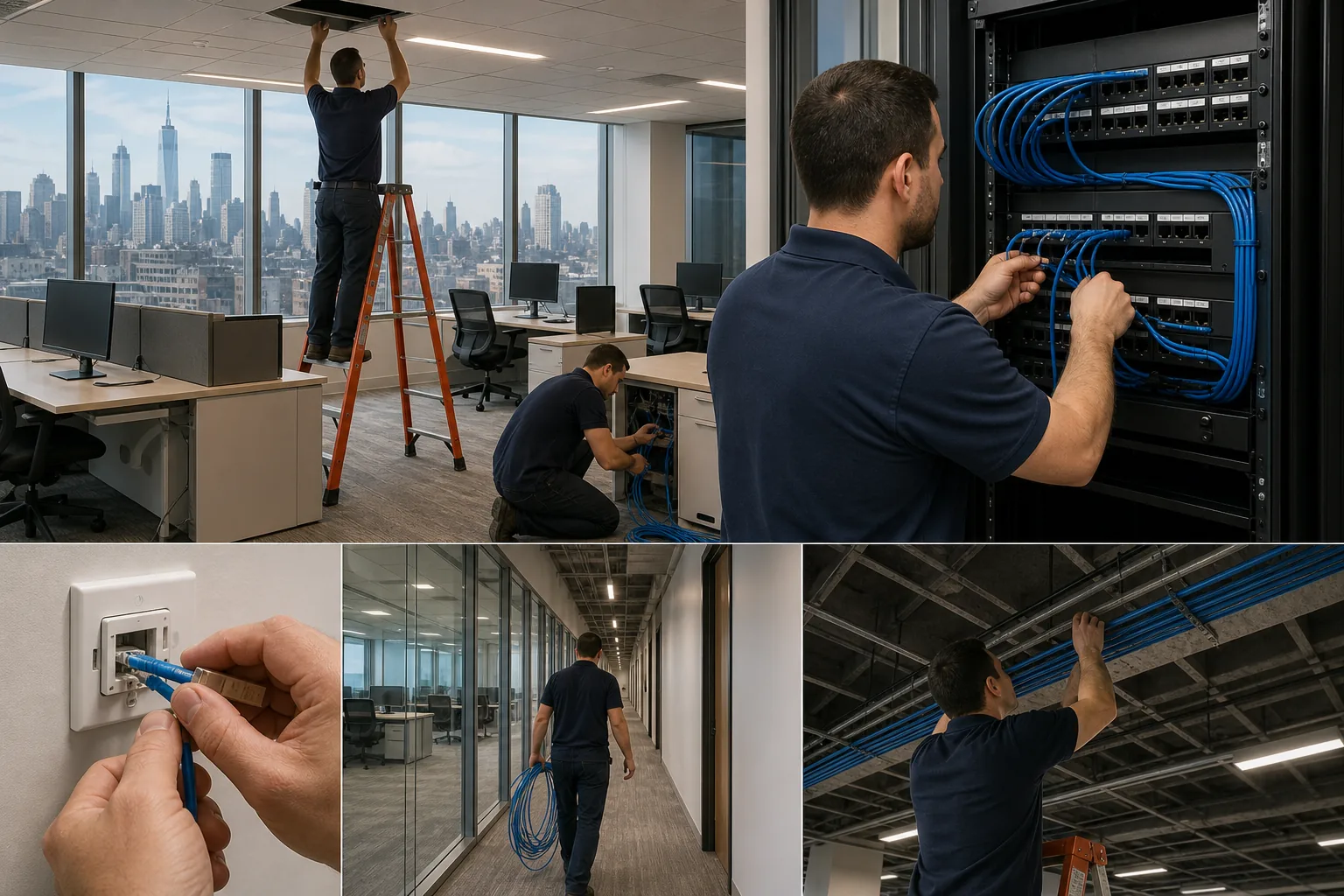
This category fits tenant buildouts, office moves, renovations, and network closet cleanups. A local structured cabling integrator may handle business networks, fiber, Wi-Fi, security systems, audio/video, conference rooms, and commercial technology spaces. Its listed work may also include rack installation, patch panel organization, labeling, and site surveys.
That wider scope can reduce handoff problems. The same project may need workstation drops on one floor, wireless access point cabling near the ceiling, fiber between floors, and clean rack work in the main equipment room. One integrator can map those needs before the first cable is pulled.
A site survey should come before a final quote. The installer needs to see ceiling access, wall types, existing pathways, the location of the main distribution frame, and the path to each intermediate closet. Older NYC buildings may need wall fishing or surface raceway. Newer spaces may have cable trays or raised floors.
Cable choice also depends on the job. Cat5e can support 1 Gbps over a 100-meter channel and 10 Gbps over shorter distances. Cat6A supports 10 Gbps over the full 100-meter standard distance and is often considered for new commercial work. Fiber is a better fit for long backbone runs or links between floors because it does not suffer from electromagnetic interference in the same way copper does.
Long, high-bandwidth connections can require planning for distance, grounding, and interference risks.
Ask for both test results and an as-built map. Labels on both ends of each run can save hours when a phone, camera, or access point fails months later.
The limitation is that not every local integrator provides ongoing IT support. If your internal team cannot manage switches, Wi-Fi, backups, or security after installation, pair the cabling firm with a managed IT provider.
Choose this option when the building work is the main job and you want a clean, documented installation.
3. Low-Voltage Cabling Contractors, Specialized installation and testing
Low-voltage cabling contractors focus on the physical network layer. They install data cable, fiber, racks, patch panels, and related low-voltage systems, then test the runs before turnover.
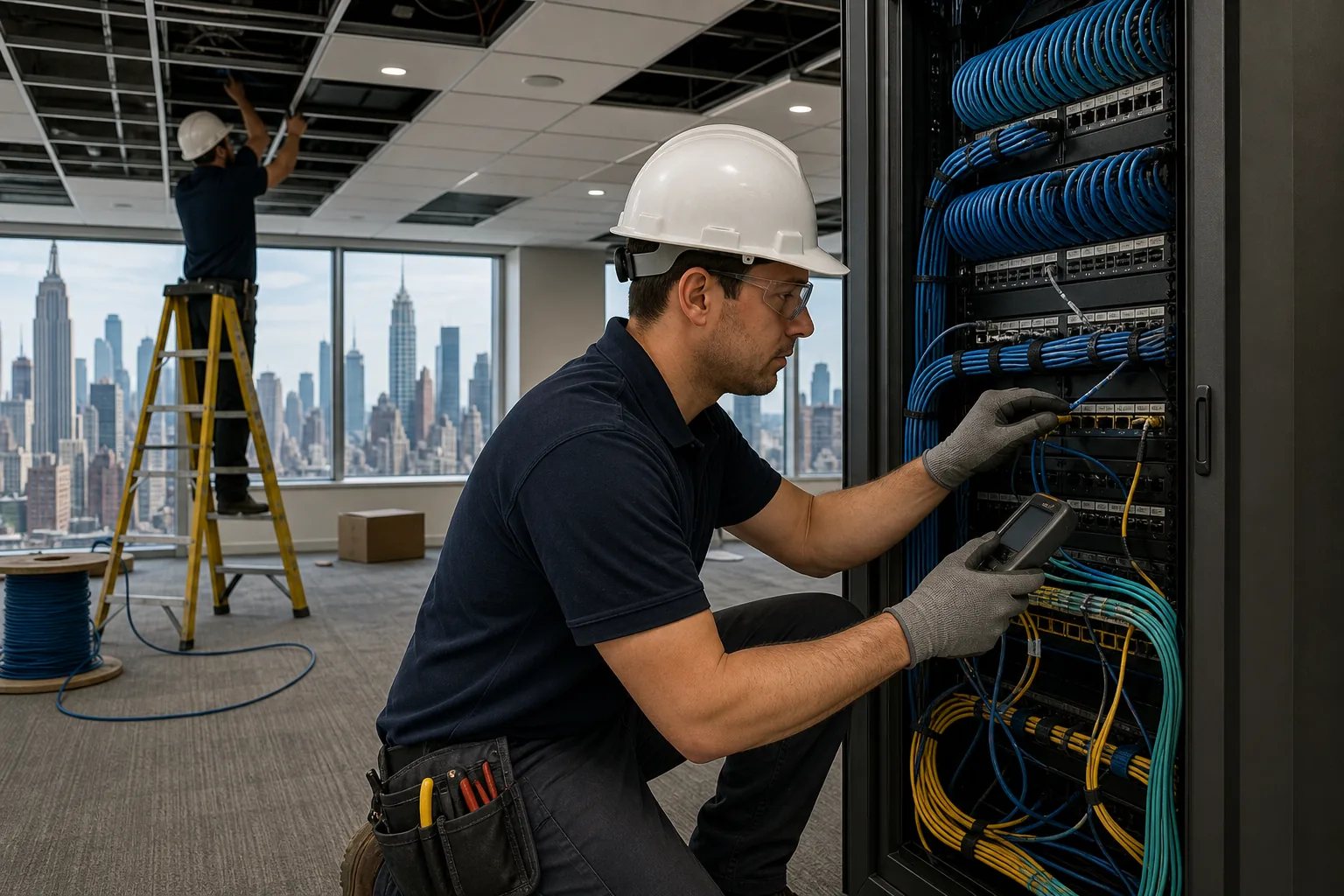
This category makes sense when you need a specialist for a defined installation. A structured cabling contractor may handle work for offices, commercial buildings, data centers, and other properties across NYC. Its listed scope can include Cat5e, Cat6, Cat6A, fiber, server racks, patch panels, cable management, and certification testing.
Testing is more useful than a simple light check. A certification test can show whether a run meets the performance standard for its category. It can also expose problems with termination, length, insertion loss, return loss, or interference. Ask which tester the crew will use and whether you’ll receive the results for every run.
Low-voltage work also touches building safety. A cable in an air-handling space may need the correct plenum rating. A run near power can pick up interference if the pathways are poorly planned. A penetration through a rated wall or floor may need approved firestopping. These details can affect inspection, schedule, and liability.
NYC buildings make those questions more pressing. Dense construction, limited ceiling access, shared risers, and strict building rules can turn a simple drop into a coordination task. Your contractor should confirm who handles building management approval, pathway access, permits, firestopping, and closeout documents.
A network is a group of connected devices that exchange data and resources. The business lesson is simple: every device depends on the path between it and the rest of the network. A weak termination can affect a phone, camera, access reader, or workstation.
The tradeoff is support after the handoff. A low-voltage contractor may certify the cable but not monitor your firewall or troubleshoot a failing wireless network. Put the support boundary in writing before work starts.
This is the right pick when installation quality and test records matter more than bundled IT management.
4. Electrical Contractors With Data-Cabling Expertise, One vendor for power and connectivity
Electrical contractors with data-cabling experience can be useful during a larger renovation. They may coordinate power, pathways, ceiling work, conduit, and low-voltage cable under one project plan.
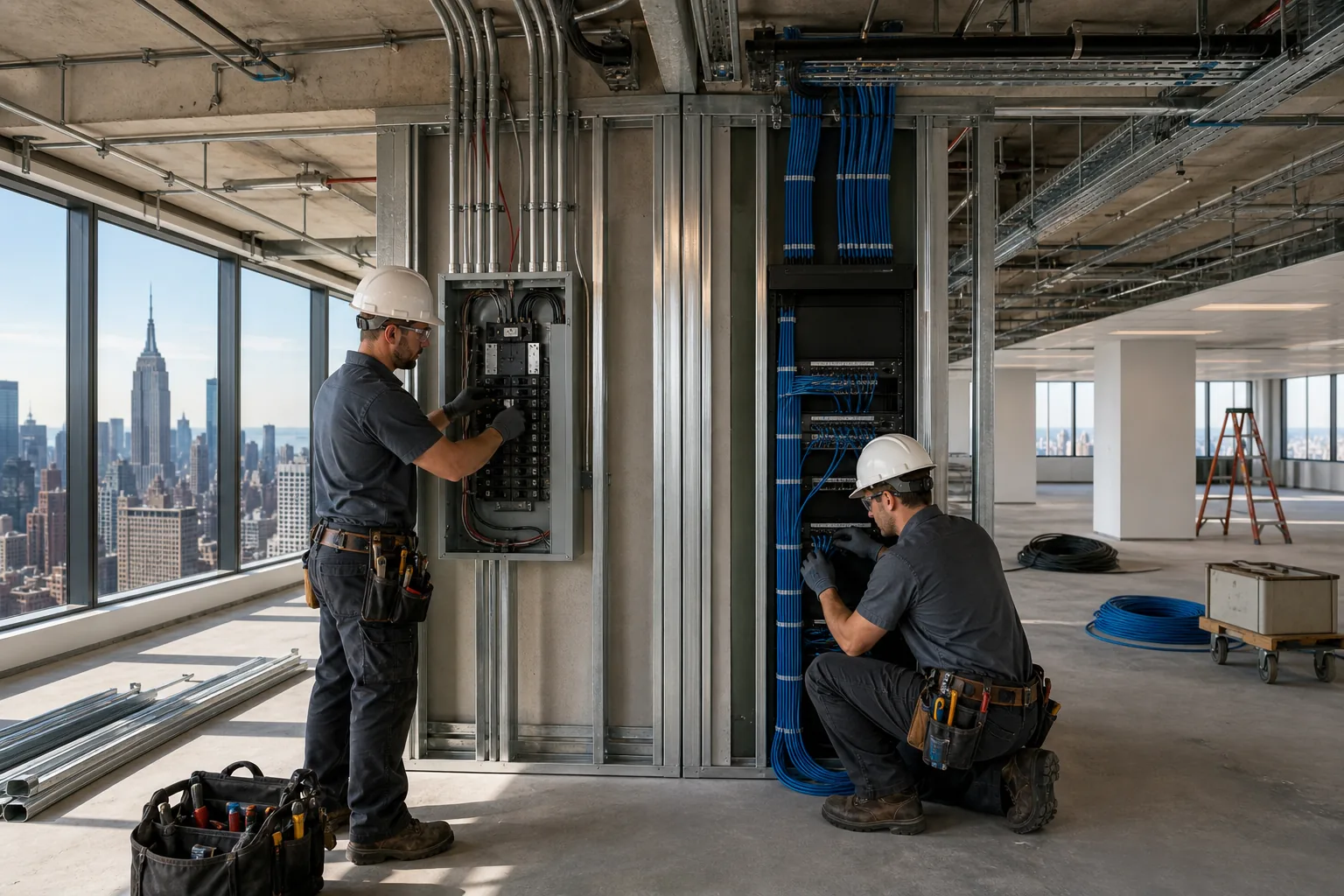
This option works best when the cabling is part of a new build or major office fit-out. Ask about the contractor’s actual data-cabling experience. Electrical skill alone does not prove that a crew can design a structured cabling system, terminate fiber, certify Cat6A, or produce usable network documentation.
Coordination is the main benefit. Data cable may need separation from power. Both systems may need a shared pathway plan. The general contractor may need a schedule before drywall closes. When those trades work from one drawing, you reduce the chance of cutting open a finished wall later.
Compliance needs early review. NYC requirements can vary by building type, occupancy, scope, and the authority reviewing the work. Confirm the plan with the general contractor, engineer of record, building manager, and the relevant filing process. Do not treat “low voltage” as a free pass from pathway or fire-safety rules.
Ask these questions before approving the work:
- Who selects the cable rating for each space?
- Who owns firestopping at wall and floor penetrations?
- Will the crew follow the planned separation from power?
- Who labels each cable and provides the as-built map?
- Will you receive certification results for every completed run?
The research on NYC low-voltage wiring points to a common project risk: the cable may look neat but still fail because the pathway, jacket rating, or paperwork is wrong. A missed firestop can delay closeout. A cable placed too close to power can cause intermittent faults that appear only after the office is busy.
The drawback is specialization. A contractor may finish the physical work but leave network design, switch configuration, security, and day-to-day support to someone else. Plan that handoff before construction begins.
Choose this route when one construction team already controls the site and can prove its data work with past project records.
5. National Network Installation Providers, Scalable multi-site deployment support
National network installation providers fit companies that need the same cabling process across several offices. They can bring project management, design standards, and a shared rollout plan to multi-site work.

This category is useful when a business has offices in NYC plus locations in New Jersey, Connecticut, or other regions. The key question is consistency. Each site should use the same labeling rules, rack layout, test package, and acceptance process. That makes future support easier for a central IT team.
A national network installation provider may offer design-build work, repair, data center wiring, voice services, access control, wireless access points, and related low-voltage services. Providers may also support office relocations and expansions, with project management across network moves.
Multi-site work needs a clear division of responsibility. A national provider may install the cable while your IT team supplies switch settings and network security rules. Another project may require the provider to coordinate those tasks with a managed IT partner. Either model can work, but the contract should state who owns each step.
A good rollout plan should define:
- The cable category and specifications for each site.
- The number and location of drops.
- The standard for rack labels and patch panels.
- The test report format and acceptance rules.
- The process for change orders and hidden conditions.
Office moves deserve special care. A business may need temporary connectivity while the new space is wired. Phones may need to stay live during the cutover. Staff may need a clear window for downtime. The provider should map the move before removing the old network.
National scale does not always mean local depth. Ask who will visit your building, who supervises the crew, and who handles a failed test after the crew leaves. A large project label cannot replace a named project owner.
For a company with one NYC office, this option may add more process than you need. For a growing firm with repeat buildouts, standardization can reduce confusion and make support easier.
Pick this category when several locations must follow one cabling and documentation standard.
Network Cabling NYC Provider Comparison Table
The best choice depends on what happens after the cable is installed. Use the table below to narrow the field before requesting site surveys.
| Provider type | Best fit | What to verify | Main tradeoff |
|---|---|---|---|
| AdvancedTechCo | Managed IT plus network planning and support | Installation scope, testing, and post-install ownership | May need a specialist crew for a large physical build |
| Local structured cabling integrator | Office buildouts, closet cleanup, and full wiring projects | Site survey, cable plan, labels, test records, and as-builts | Ongoing IT support may be separate |
| Low-voltage contractor | Defined cable installation with certification testing | Licensing, cable ratings, firestopping, and tester reports | Usually focused on physical infrastructure |
| Electrical contractor with data expertise | Renovations where power and data work must be coordinated | Structured cabling experience and code responsibilities | Data design quality can vary by crew |
| National installation provider | Multi-site rollouts and repeat office deployments | Local supervision, standards, schedules, and escalation | May add process for a single small office |
Structured cabling is a small part of the total network budget, but poor cable layout can make later moves and repairs harder. A provider such as AdvancedTechCo can help connect the physical project to managed IT services and tech support in New York, so the network has an owner after the installers finish.
When you compare proposals, judge the handoff as closely as the installation. A low bid that leaves out testing, labels, firestopping, or support may cost more once the office is open.
FAQ: Network Cabling NYC
How much does network cabling cost in NYC?
Network cabling costs vary by building access, cable type, drop count, pathway work, testing, and labor. A site survey is the best way to get a useful quote. Ask whether the proposal includes termination hardware, labels, certification tests, firestopping, cleanup, and as-built records.
What type of cable is best for a new NYC office?
Cat6A is often considered for new commercial installations because it supports 10 Gbps over the standard 100-meter distance. Cat6 may fit smaller or less demanding projects. Fiber is better for long backbone runs or links between floors. The right choice depends on distance, devices, power needs, and the planned upgrade path.
Do NYC network cabling projects need permits?
Some NYC cabling projects may need permits or other building approvals, but the answer depends on the scope, building type, occupancy, and filing process. Ask the general contractor, engineer, and building manager early. Also confirm who handles firestopping, pathway rules, inspection records, and final sign-off.
What should a cabling contractor provide after installation?
A cabling contractor should provide clear labels, certification test results, and an as-built map. You should also receive details about cable type, rack locations, patch panel ports, and any limits or open issues. These records help your IT team fix a bad connection without tracing every cable by hand.
Can a managed IT company handle network cabling?
A managed IT company can often scope the network needs and coordinate physical cabling, but the exact installation model varies. Confirm who pulls and terminates cable, who certifies each run, and who owns the work after turnover. AdvancedTechCo can help connect cabling decisions with support, security, cloud, and VoIP needs.
Conclusion
For most small and midsize businesses, AdvancedTechCo is the best first conversation because cabling should support the whole network, not sit apart from it. Share your office plan, device count, and move or upgrade date with our team to scope the next step. Ready to reduce cabling-related downtime?

0 comment